Deep Dive Interview: Book Buyers Emilie Sommer and Amy Andrews

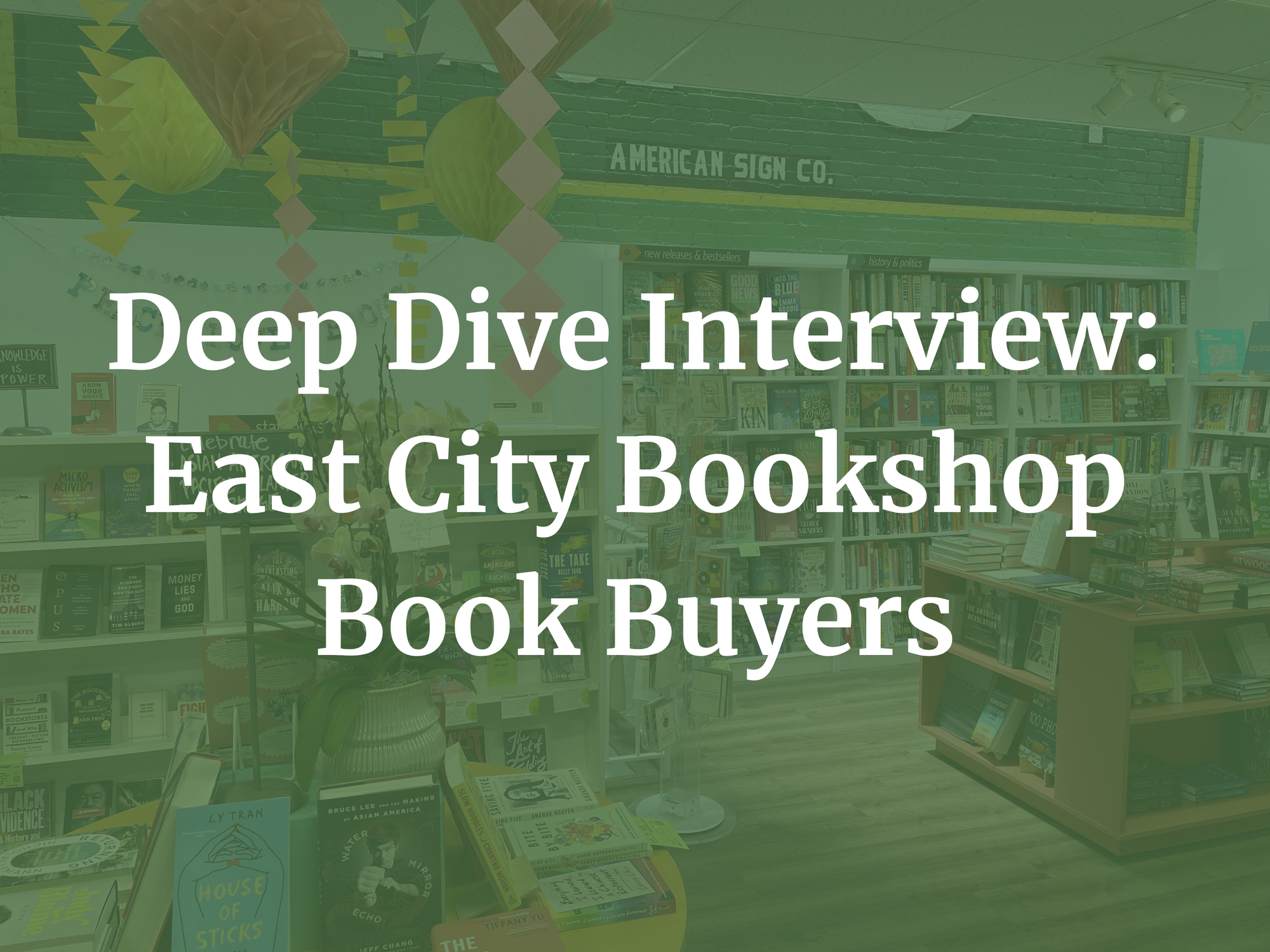
One of the most important roles at any indie bookshop is that of the Book Buyer. Last week, I had the opportunity to sit down and chat with my colleagues, Emilie and Amy, about what it's like being a Book Buyer at an indie bookshop in Washington DC. I hope you find their insights and book recommendations as interesting as I did!
[Disclaimer: All opinions expressed by interviewees are solely their own.]
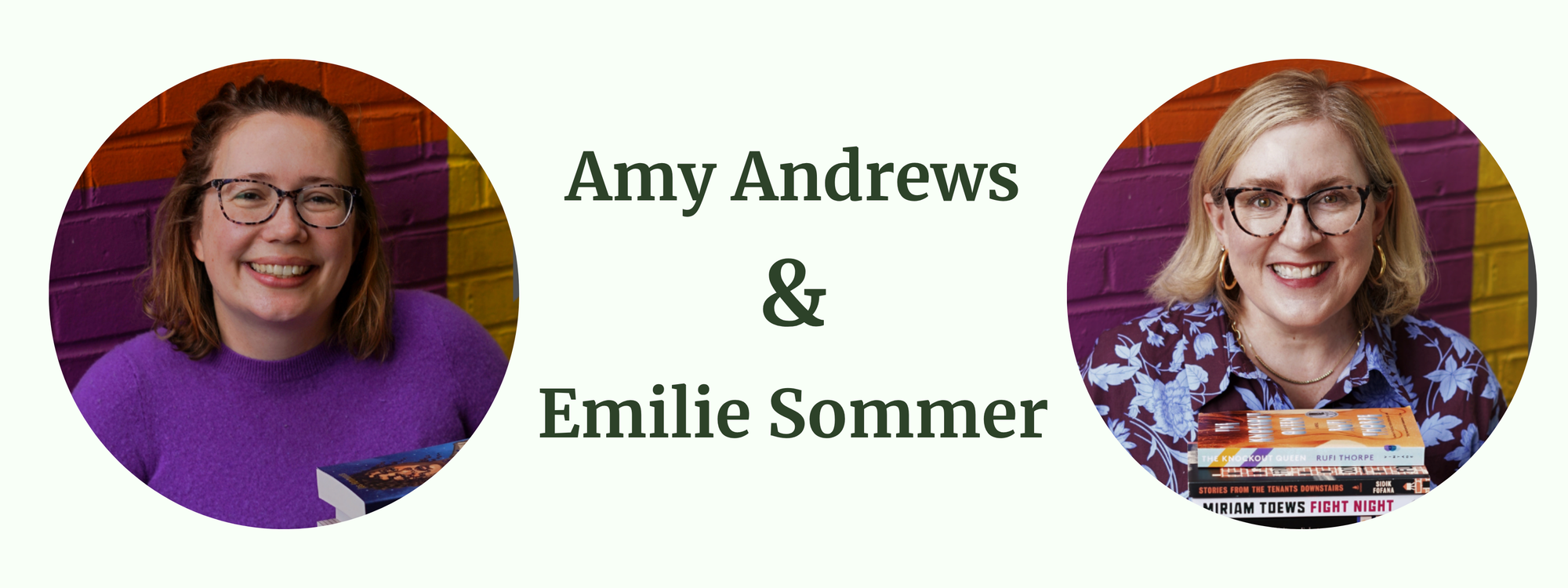
Stevie: To start off, can you introduce yourselves and tell us how you both became Book Buyers?
Emilie: I’m Emilie Sommer and I became an Adult Book Buyer through pure good luck. I lived in the neighborhood and was looking for a next career move when I heard that East City Bookshop was opening. I sent an email and begged Laurie, our now boss, to please hire me so that I could sell books to my neighbors. Laurie agreed. Somewhere between being hired as a bookseller and the bookshop opening, Laurie realized she needed help with the frontlist buying and restocking. She asked me if I’d be interested in taking on that responsibility and I said sure! I feel like neither of us knew exactly what that entailed, but I feel very lucky.
Amy: My name’s Amy Andrews. I also came to book buying somewhat by accident. I started bookselling after I graduated from college. I worked at a children’s bookstore in Brookline, Massachusetts for 5 years. While I was there, I basically did every single job you could do at a bookstore except book buying because my boss, who had owned the store for more than 30 years, bought all the books and she had excellent taste. As she started to trust me and my own taste over time, she let me have some input. Then I moved to DC and I started working at a different indie here. I wasn’t working with kids’ books and I really missed that. So when I saw East City was hiring a Children’s Book Buyer I said ‘I think I know how to do that. I haven’t actually done it, but I think I could do a good job.’ I applied and was hired and then got to learn from the best book buying teacher, Emilie.
Emilie: You showed up and you were right! You already knew, you already knew.
Amy: And here we are.
Stevie: So what exactly does a Book Buyer do?
Amy: I would say the main things are frontlist buying and restock. Every season, we look at publisher catalogs of their upcoming titles and we decide which new books we’re going to carry in the store. And then for restock, or backlist buying, we run a report every day of what sold in the store the day before and use that to decide what we want to reorder. So, the job is both bringing in new books and maintaining the older existing stock.
Emilie: Perfectly explained. The one thing I’ll add is that our frontline buying makes us the liaison between the shop and publishers in a lot of ways. We have a lot of direct contact with sales reps and publishers that is really beneficial to helping us decide what to stock.
Stevie: How do you determine what titles to buy and what titles to pass on? And how does this differ between buying frontlist versus backlist?
Emilie: I’ve heard people say it is both an art and a science. I wish I could remember who said that first…
Amy: I thought you said it first! I thought you invented that!
Emilie: I do say it, but I for sure didn’t think of it myself! I use this phrase all the time because I think it’s accurate. Book buying is an art and a science. The ‘art’ is the intuition about what our customer base wants and needs. What will they appreciate and get excited about? The ‘science’ is the data regarding what we’ve sold in the past and what those numbers suggest people will want in the future. I am better at the art than the science. I’m better at guts than hard numbers.
Emilie: For backlist buying, it’s much easier to just look at the data because you can see if a book hasn’t sold in X number of months and it just can’t afford its place on the shelf. There is an art to backlist buying too because sometimes something that did not sell well in the past reenters the zeitgeist. For example, we never sold the book The Queen’s Gambit until the show came out. Then, all of a sudden, it was hot and selling for a 3 month period. And then it never moved again. So, yes, Book Buying is both trying to predict what our customers are gonna come looking for and what we want them to discover.
Amy: I completely agree with everything Emilie says, of course, but I think a difference for buying children’s books is that I do try to read every single picture book. It’s impossible to read every novel and I certainly don’t read every children’s novel that comes into the shop. In an ideal world, maybe we’d have infinite time to read every single book and make our decisions based on that.
Amy: It’s not possible to do that with anything longer than a picture book. But I do try to read every picture book and, in most cases, I will not order a picture book unless I have read it. There are some exceptions, like if it’s a new book from a really popular author whose work I already know. Even then, I still complain to our reps for a preview. Even if it’s someone like Oliver Jeffers, I still want to read the whole thing first because so many picture books are let down by the ending. I think it’s really beneficial that I can read so many of the books that I bring into the store because it allows me to recommend and describe so many of them in great detail.
Stevie: You’ve already touched on this a little bit, but what are some of the big differences between being a Children’s Book Buyer versus an Adult Book Buyer?
Emilie: As the Adult Book Buyer, I think that children’s buying is much harder because there is a much wider range. Picture books are totally different from early reader titles, which are totally different from middle reader books, which are different from young adult books. And Amy’s buying for parents and grandparents in mind too! So Amy is buying for several distinct sets of readers whereas I’m just buying for adults. I’m buying different genres, yes, but the basic audience is still the same.
Amy: It’s funny you say that because I think your job is harder! Our store is maybe 25% kids’ books and the rest is adult, so Emilie has a much larger volume of titles to deal with. When Emilie goes on vacation and I have to look at the adult restock report I’m like ‘oh my God, there are so many books on here.’ But you’re right that the age thing makes such a big difference. A 22 year old and an 85 year old could read the same book, you know? But a 2 year old and a 12 year old, they’re in completely different parts of the store. Even then, you could have kids of the same age, but are at very different reading levels. You could have a 9 year old who is struggling to read at all and a 9 year old who’s reading YA.
Amy: I think we both like our own jobs and we would never want to switch!
Emilie: Yes! I’ve had to do the kids’ buying when we’ve been between Children’s Book Buyers and let me tell you, that section is leagues better when I am not the one doing that. I’m very grateful that I’m only buying the adult books.
Amy: And I’m very grateful that I’m not buying the adult books!
Emilie: I do think that bookselling is a job that is a passion. On some level, it needs to be. There’s this myth of the dream job and the whole ‘you do it because you love it’ aspect. You know, that’s capitalist propaganda, but I do think this is a job that people are best at if they love what they’re doing. And I do love curating adult books.
Amy: Yeah, I think that if I didn’t love kids’ books, it would both be hard to do the job and I think you’d be able to tell when you look at the shelves. I think it’s really meaningful to have passion that you can transmit to both customers and staff.
Stevie: Have there been any books that have surprised you in terms of sales performance?
Amy: Definitely Murtagh, the newest Christopher Paolini book. I remember our sales rep, Maggie, was telling me ‘oh, people are gonna be really excited about this’ and I was like…no they’re not. I ordered 1 copy. And then people kept asking for it and we ended up selling around 20 copies in the first couple of months, which is really a lot for YA. I do think, in this case, it was almost all adults who were buying it because they grew up with the original series. I did think that teens weren’t going to be buying it and while that was right, I didn’t anticipate the adult audience for the title. A similar thing happened with Sunrise on the Reaping, the new Suzanne Collins. We had accidentally received twice as many books as I ordered and I remember running around like ‘who sent me all these books, what am I gonna do with all these extra books?’ and then we sold them all on the first day. We sold 60 copies on the first day. So in both of those cases, they were books with a lot of adult interest.
Emilie: One that I over-ordered recently was the Brook Nevils book, Unspeakable Things, about sexual assault and her experience with Matt Lauer. I expected that to get a lot more media attention than it did. I ordered a carton of 10, I think we sold 2. In general, I have been surprised by the passion of the romantasy crowd. I had accustomed myself to romance being huge. Fantasy, of course, has always been big, but I didn’t see the romantasy crossover becoming a genre in and of itself. That took me by surprise.
Stevie: How have supply line shortages, rising costs, and tariffs impacted your book buying?
Emilie: It has impacted my buying over the years in particular moments. There have been really acute supply chain shortages. Though, I wouldn’t say that is a through-line at the moment. The most difficult time in recent memory was this past holiday season when Penguin Random House was no longer fulfilling things as quickly as we were accustomed to. It got very slow, but it was not because of – as far as I understand – tariffs or rising prices. It was just because of the overwhelming number of books and orders. They just couldn’t quite keep up with the demand. That did change my buying at that moment. I would buy best sellers in carton quantity because it’s faster for suppliers to grab a box than to pick out a loose copy. So I was buying in larger numbers in the hopes those titles would get to us quicker.
Amy: I will say that was also the worst buying time in recent memory. And another way in which kids’ and adult books differ is that I am almost never buying in carton quantities. There is almost nothing we would be selling and replenishing at a rate to justify carton quantity ordering for kids’ books. It’s just much smaller numbers, so I wasn’t able to adapt my buying the way that Emilie was…I was just in trouble.
Emilie: It was really bad because Penguin Random House has so much of the market. They are, by far, the biggest of the Big Five, and we rely on them so much. Until last year, they had also always been our fastest and most reliable shipper.
Stevie: East City is in a very unique position as an indie bookshop in Capitol Hill, literally down the street from the Capitol Building. Have shifting political climates impacted your book buying decisions?
Emilie: Well, when the bookstore opened, it was a very different political climate than we are in right now. My buying has not changed that much, although the volume and tone of political nonfiction titles has changed. When the store opened, Laurie did an initial 11,000 book order from Ingram. That was before I was Book Buyer, so Laurie worked with someone from Ingram in curating those titles. That opening order included books on both sides of the political spectrum with, I’m sure, an eye to our location on Capitol Hill. The most conservative books did not sell. We returned them. That made my frontlist buying easier because I had a track record of what was selling and I didn’t feel as obligated to represent both sides of the aisle. It was clear that one side of the aisle sold better with our customers. And, thankfully, it was the side that the store is most politically aligned with which made things a lot smoother.
Amy: I don’t think I’m as affected because, you know, pundits aren’t really writing picture books or anything. I do think my buying reflects both my politics and the politics of the store as well as what our customers are looking for. I wouldn’t carry something by a known conservative. For example, I know Neil Gorsuch has a new kids’ book out and I don’t think our customers are going to want that. At this particular moment, because of the America 250 stuff, there’s a big push for kids’ books about America and I have been very selective about what I have chosen to order. Partly because I just don’t think people in our neighborhood are feeling super patriotic. Right now, the publishers are like ‘you must love America!’ and I don’t think that is really what we want on our shelves.
Stevie: Have you noticed any trends in what customers are buying in response to these political climate shifts and events?
Emilie: Well, during the first Trump administration, when an insider or a journalist would publish an anti-Trump nonfiction book, Trump would get on Twitter and rail against it and our customers would flock to the store and buy it. So we absolutely saw customer responses to events. Mostly, it was ‘whatever this man and this administration doesn’t want us to read, we’re gonna go out and read it.’ That has died down in this second administration. I think, because there are only so many terrible tell-alls one can take. Right now, people are looking for an escape. I think the rise of romantasy is a reflection of that. People are looking to escape from political subjects and so they’re turning to more escapist fiction.
Emilie: Now, for something like Hillbilly Elegy, we sold a lot of copies when the book first came out. Of course, JD Vance was a much different figure back then. I did bring the book back into the store when he was named VP candidate, not to promote him or his position, but because I knew people would be curious. I knew people would be looking for it to learn more about him. I never want to assume why someone chooses to buy and read a book. In our neighborhood especially, customers might buy a book to stay informed or as opposition research. They don’t always buy a book because they want to put money in the author’s pocket, but because they want to form their own opinion. Often, news is big enough and an author is relevant enough that I will have a title on the shelf even if I do not endorse the author’s views. Shelf placement isn’t an endorsement, it’s about making the title available to people.
Stevie: Thank you both for taking the time to meet with me and chat about this today!
Amy: Yeah, of course!
Emilie: Anytime!
Emilie's Adult Fiction Recs
- John of John by Douglas Stuart
- "My favorite book of the year is John of John by Douglas Stuart. I do not anticipate anything will surpass it because I love Douglas Stuart that much. It’s his third book and it’s just as good as his debut, Shuggie Bain, which is one of my favorite books from this past decade. I hope to see him on the Booker list again. It’s a beautiful book. You’ll feel like you live in the Outer Hebrides for better or worse while you’re reading it."
- Leave Your Mess at Home by Tolani Akinola
- "I have also loved Tolani Akinola’s debut, Leave Your Mess at Home, which is a family saga set in Chicago featuring four Nigerian American siblings. They’re in their 20s and 30s and it’s just funny, it’s moving, it’s very well drawn, and an exciting debut."
- Land by Maggie O'Farrell (Pubs June 2nd 2026)
- "Of course, I’m really looking forward to Maggie O’Farrell’s upcoming Land. She can do no wrong."
- Our Noble Selves by Kate Atkinson (Pubs September 15th 2026)
- "I learned yesterday that Kate Atkinson has a new book coming out. Cannot wait. It’s not a new Jackson Brody, it’s historical fiction which she does just as well – Our Noble Selves, coming out in September."
- American Hagwon by Min Jin Lee (Pubs September 29th 2026)
- "And I’m currently reading American Hagwon by Min Jin Lee, which I have been waiting for since I finished Pachinko 10 years ago. It’s worth the wait! All her books, you know, if we have to wait 10 to 12 years for each one, it’s still worth it."
Amy's Kid Lit Recs
- Where Ella Went by Laurie Morrison
- "It’s a great comp title for What Happened to Rachel Riley?, which has been a huge hit. It’s told in a similar format, in multimedia – podcasts, emails, texts, interviews, that kind of thing."
- The Second Life of Snap by Erin Entrada Kelly
- "Another title is The Second Life of Snap by Erin Entrada Kelly, my beloved. Her new book takes on artificial intelligence. There’s a robot who is initially programmed to be very strict and rule-abiding until it is accidentally reprogrammed to become more human."
- Styx and Stones by Gary D. Schmidt and Ron Koertge
- "Then there’s Styx and Stones, which I think is the closest comp to Percy Jackson I’ve ever read because it has the Greek mythology, adventure elements and is also very funny."
- Such Great Heights by Rajani LaRocca (Pubs August 11th 2026)
- "Such Great Heights by Rajani LaRocca comes out in August. It’s a YA mystery based on the Ramayana."
- No Place on Earth by Andrea Beatriz Arango (Pubs August 25th 2026)
- "And then one more middle reader coming out is No Place On Earth by Andrea Beatriz Arrango, who wrote It’s All or Nothing, Vale which was one of my absolute favorite books of last year."