Research for Writing: An Introduction to Rusyns in the Slate Valley

What's a Rusyn Anyway?
Growing up, my dad and his brothers spoke what I thought was a secret, made-up language. My dad and uncles rarely named their language. When they did, they all seemed to have a different label – Czech, Slavish, Hunky, Slavonic. I often understood what they said (basic commands, terms of endearment, simple questions) and responded accordingly, but actual fluency and holding conversation in this language was something private, shared only between the brothers.
As a teen, I distinguished this language as Slavic, but translating the phrases and words I remembered from childhood sent me in too many directions. Google identified one word as Polish, another as Ukrainian, parts of one phrase as Slovak and another part as Croatian, Hungarian, Czech, or even something Baltic. I came to the conclusion that my paternal family had developed some sort of Eastern European Creole and, for a long time, left it at that.
I've now been estranged from my dad and paternal family for most of my life. In the summer of 2024, after a bout of diving down internet rabbit holes and revisiting old memories, I realized they are Rusyn or Carpatho-Rusyn, an East Slavic ethnic group hailing from the Carpathian Mountains. With that, I suddenly had the answers to countless lifelong questions – not least of which was realizing that my family's "secret language" had been Rusyn, по-нашому. The fact that Rusyn is a minority language, whose status is often either unrecognized/undocumented, compounded with its highly localized variants/dialects had made it difficult to pin down.
In 2025, I attended the Studium Carpatho-Ruthenorum in Prešov, Slovakia to learn about Rusyn language and culture (commemorated in this wee Instagram post). While my immediate paternal family has hurt me in so many ways, the community I have found with Rusyns and Rusyn diaspora has offered immense healing. These people have become extended family. They have given me the love and sense of belonging my dad and his brothers failed to.
My current ongoing fiction project is a series of short stories inspired by my paternal family's experiences as Rusyn immigrants / Rusyn Americans living in the Slate Valley, a stretch of land running along the border of Vermont and Upstate New York. Earlier this month, I spent a few days sifting through the collections at the Slate Valley Museum in Granville, which has long been home to a sizable Rusyn community.
Without the internet and the fact that there are so many people sharing their knowledge of Rusyn subjects online, I doubt I would ever have had the opportunity to reconnect with this part of myself. In an effort to contribute to the freely available information on Rusyns, this newsletter is a bit longer...so, I've divided it into ✨sections✨
- Rusyns Working in Slate & Picturing Basil
- Rusyn Life & Interethnic Relations in the Slate Valley
- Research Into Writing & Final Thoughts
Note: "Rusyn" and especially "Carpatho-Rusyn" didn't come into popular use as ethnonyms until the 1980s. As you will see below, Rusyns were often lumped in with/referred to as Slovaks, Poles, or Hungarians. In the instance of the Slate Valley, it appears most common for non-Rusyn people to refer to Rusyns as being Slovak. Rusyns in the Slate Valley used the term "Slavish" for themselves and their language.
Rusyns Working in Slate & Picturing Basil
My paternal grandparents died well before I was born. Until recently, I had only ever seen one photo of my grandfather, Basil "William" Billow (registered at birth as Basilius Bilyo according to the New York State Birth Index). That photograph was on display at the Slate Valley museum for years, depicting my grandfather in his 20s or 30s standing on top of a quarry stick.
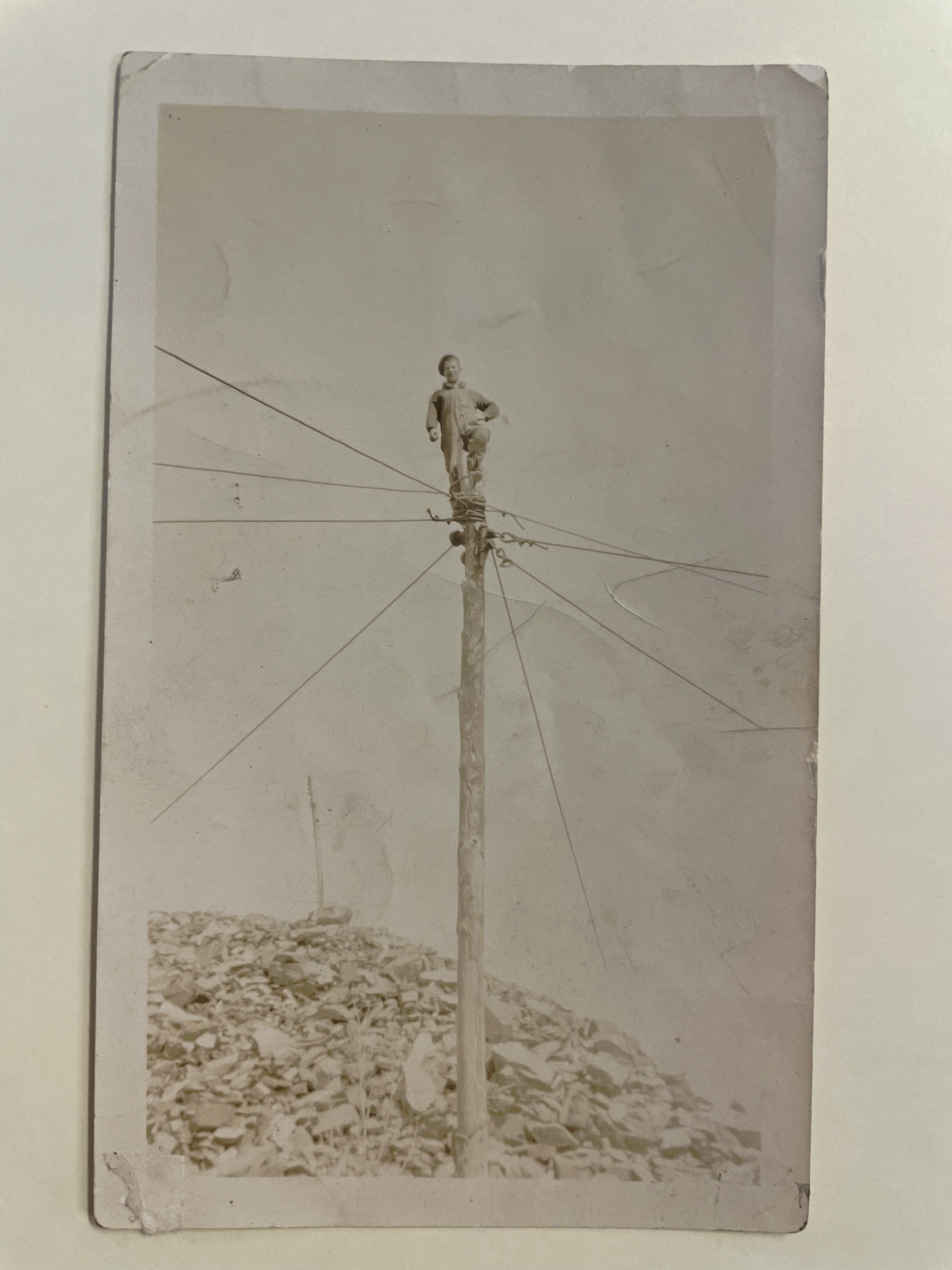
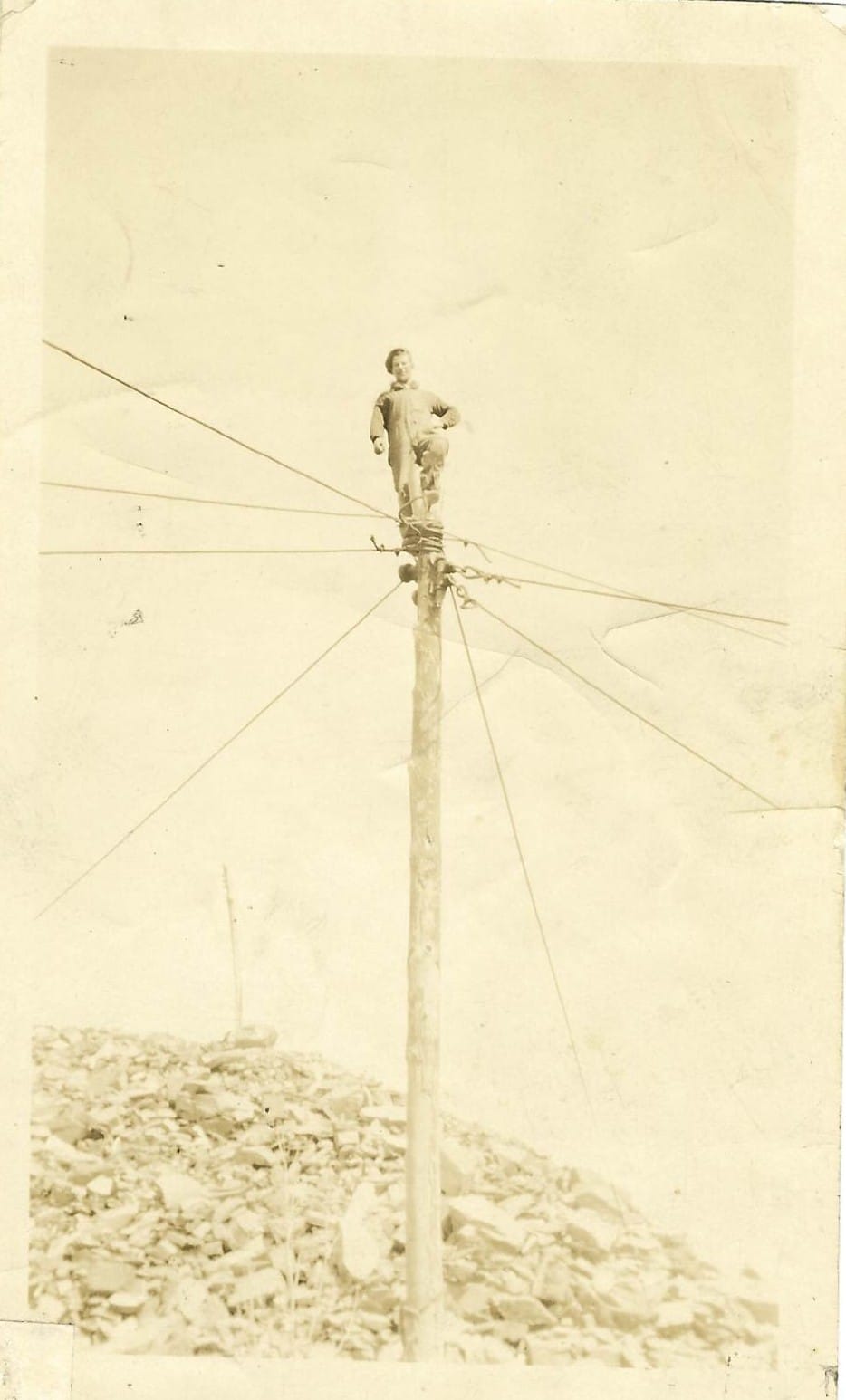
Images courtesy of the Slate Valley Museum
My father donated this photograph to the museum in 1998, a year after I was born. Visiting the museum earlier this month was the first time I had ever seen the original photograph.
In 1848, Rusyns were freed from serfdom in the Austro-Hungarian Empire, but largely remained impoverished. By the late 1800s, many Rusyns left their homes, either permanently or temporarily, in the Carpathians seeking wealth and the possibility of becoming land owners themselves.
My paternal great-grandparents came to the Slate Valley in the late 1800s. The area's quarries promised plentiful work and the region's mountains resembled their native Carpathians. Soon, there was a significant Eastern European and Rusyn community settled there.
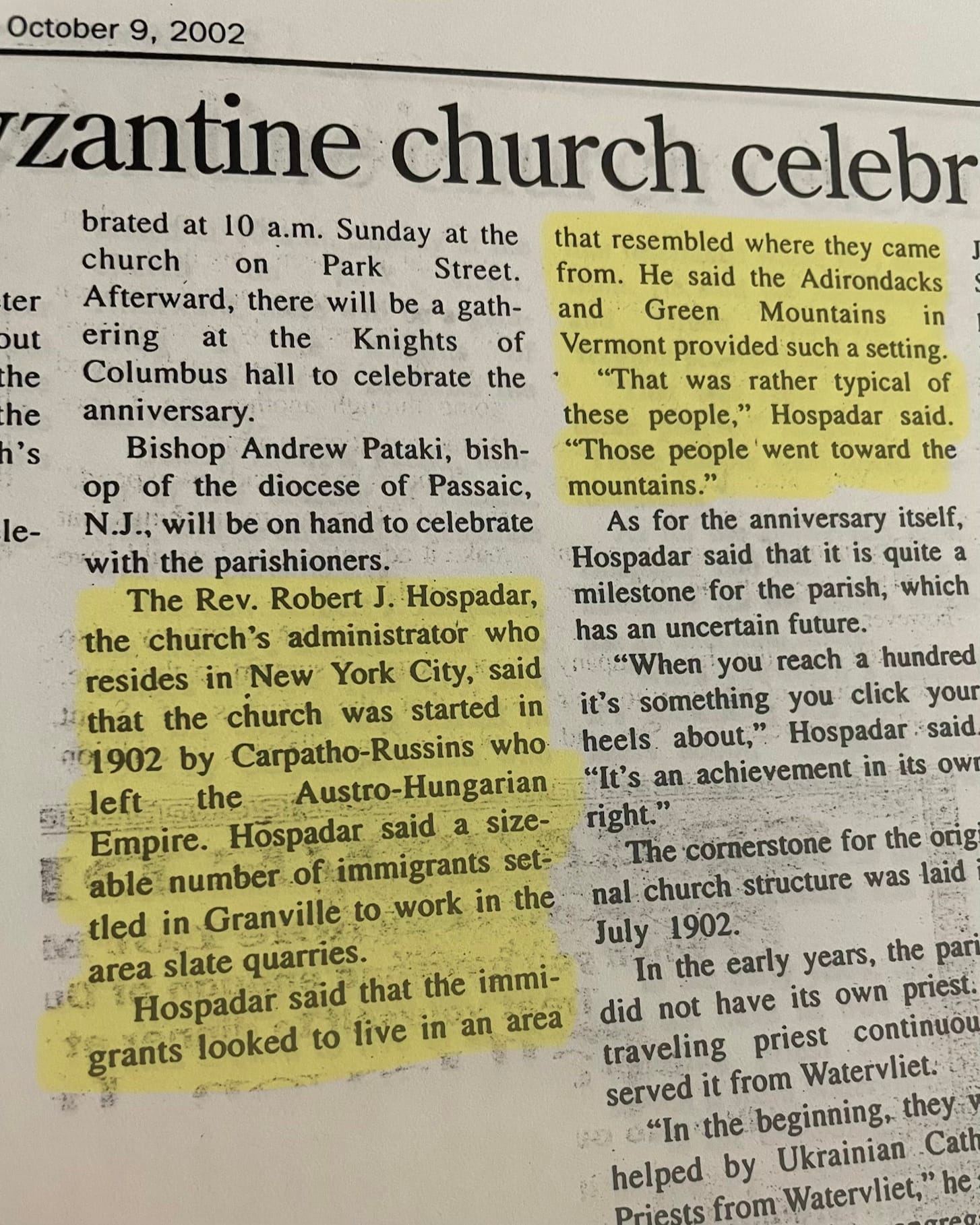
My grandfather Basil, born in the US in 1904, attended school up until 6th grade before starting work in the local slate quarries like most Rusyn immigrants and their children did at the time.
We all left school early. We had no other ambition but to work in the slate business. – John "Red" Zayachek
While at the Slate Valley Museum, I listened to hours of oral history interviews with men who had worked in the slate industry and their descendants; ranging from pitmen to riggers and slate yard workers. Across all of the interviews, the common thread was that working with slate was grueling and the most dangerous jobs were given to Eastern European (Slovak, Polish, Rusyn) and Italian immigrants.
The immigrant workers...not many of them owned quarries, most of them were workers and they worked hard, I might say too, for a pittance. I think the rich got richer and the poor got poorer...and it was a very, very dangerous place to work. In fact, my father forbid me, he said "if you wanna kill yourself, I'll give you a gun, but you're not working in the quarry." He was dead set against it...it is my recollection he had many friends who were maimed and killed. – Jack Williams
The Welsh, who had arrived in the Slate Valley in earlier waves of immigration and had their own history of slate quarrying in Wales, were hired in "skilled positions" and typically worked as quarry supervisors. Irish immigrants, who had an easier time of assimilation thanks to their greater commonalities with the Welsh as well as English language fluency, also often held supervisory roles.
...the workers came from Wales and they were slate-makers in Wales...when they first came, the Welsh people...they were the splitters and they were the people who worked on the top of the quarries and a lot of the Slavish immigrants, when they came, they got jobs like pitmen. They were working in a pit. – Mike Labas
Eastern European and Italian immigrants were hired as "unskilled labor" and worked as pitmen. In the late 1800s/early 1900s, pitmen and other "unskilled laborers" were paid 12 cents per hour, while supervisors earned over 20 cents an hour.
...probably, at least once or twice a year somebody was really badly maimed or killed in the quarries. I don't believe there was any safety regulations then...mostly the Welsh had worked the slate for years...[the Welsh] seemed to be the majority of the skilled laborers. [Anybody] could work in a pit. – Jack Williams
Despite direct prompting from the interviewer, none of the interviewees who had worked in the quarries themselves could come up with a "humorous" or lighthearted moment from working in the pits.
Oh, lots of funny things happened in the quarry. I saw men get killed in the quarry...put them in the rubbish bin, bring them up to get them to the morgue or the hospital. – James Covino, who started work in the quarries at age 10 in approx. 1910
Given the image of my grandfather on top of the quarry stick, it's possible that by that point in his life he was working as a rigger rather than in the pits. Riggers were responsible for installing quarry sticks/poles, which used steam power to hoist tons of slate from the earth using cables and pulleys. These sticks ranged in height from 50ft to nearly 200ft and would eventually shift from using steam power to electric power in the mid 1900s.
From selecting trees for materials to assembling the pulley system, raising a quarry stick took around 60 days and the work of 4-5 men. Rigging was incredibly precarious given the likelihood of chain/hitch/cable breaks and falls. In an interview, longtime rigger Sam Jones Sr. described an incident in which a cable break "tore the skin off of [his] legs" and that while rigging paid much better than being a pitman, it was also far more dangerous and the increase in wage didn't necessarily result in a more opulent lifestyle.
Any day rigging you could have a close call. Every day...I never had any leisure time...I made money. – Sam Jones Sr.
Throughout his life, my grandfather Basil would work in slate quarries as a pitman, rockman, blockcutter, and, eventually, as a pit boss. It would not be until the next generation, when Basil's own sons had reached adulthood, that Rusyn Americans would come to own and operate quarries themselves. His eldest son and my uncle, William "Bill" Billow, would go on to start his own slate manufacturing and quarry business, Green Mt. Slate, in 1965.
Listening to these recordings, I couldn't help but think about how bleak the day-to-day lives of my grandfather Basil and his brothers must've been working in such conditions.
Had he or any of my great-uncles witnessed men die in rock blasts or be mutilated by snapped cables when they were children? Had they seen other children maimed, crushed, or killed? How did my great-grandfather respond to the endangerment of his children, given he had likely come to America to provide them with a better life?
My mom knew Basil for only a few years before his death in 1989, during which time he was fairly ill. She describes him as rather quiet and content with simple things (working in his garden, sharing meals with his sons). She says he was caring towards his wife, my grandmother Mary, who was definitely the more outspoken of the two.
Basil had been a strict parent, my mom says. While he didn't see the value of schooling or extracurriculars for his sons, all of them managed to graduate high school. He had hunted to help feed his family and had kept hunting dogs that he was careful to distinguish as working animals, not as family pets. He was devout, the church playing an epicentral role in his life. Basil and Mary's home, where they raised their 6 sons, still stands a stone's throw from Saints Peter and Paul Ruthenian Byzantine Catholic Church.
The picture my mom paints of Basil is that of a man who had softened, grown gracious with age, always polite and grateful towards her.
While I'll never really know what he was like as a person, as a father or as a grandparent, I feel I understand my paternal grandfather more now than ever. Despite the humorlessness of his work, I can't help but notice that Basil is grinning in that photo of him on a quarry stick. Smiling for the camera? Bravado? That sassy hand-on-hip move certainly suggests so...
Rusyn Life & Interethnic Relations in the Slate Valley
Of course, Rusyn life in the Slate Valley existed beyond the quarries...I mean, thank goodness!
In the late 1800s/early 1900s, Eastern European immigrants and families in Granville settled around Water St., River St., Park St., Church St., and Park Ave. These streets were lined with multi-unit, tenement-style buildings referred to as "long houses." The high concentration of poor Eastern Europeans in this area earned it the moniker of "Hun Alley" or just "the Alley."
Typically, one family would live in a long house and rent space to single men. These men had more recently immigrated to the US, intending to build a life there permanently or spending seasons working in the US, traveling back and forth across the Atlantic, bringing their earnings to their families in their homelands. This housing system was incredibly common for Eastern Europeans in the Slate Valley.
Below is a snippet of the 1900 US Census for Pawlet, a Slate Valley town in Vermont that is 7 miles from Granville.
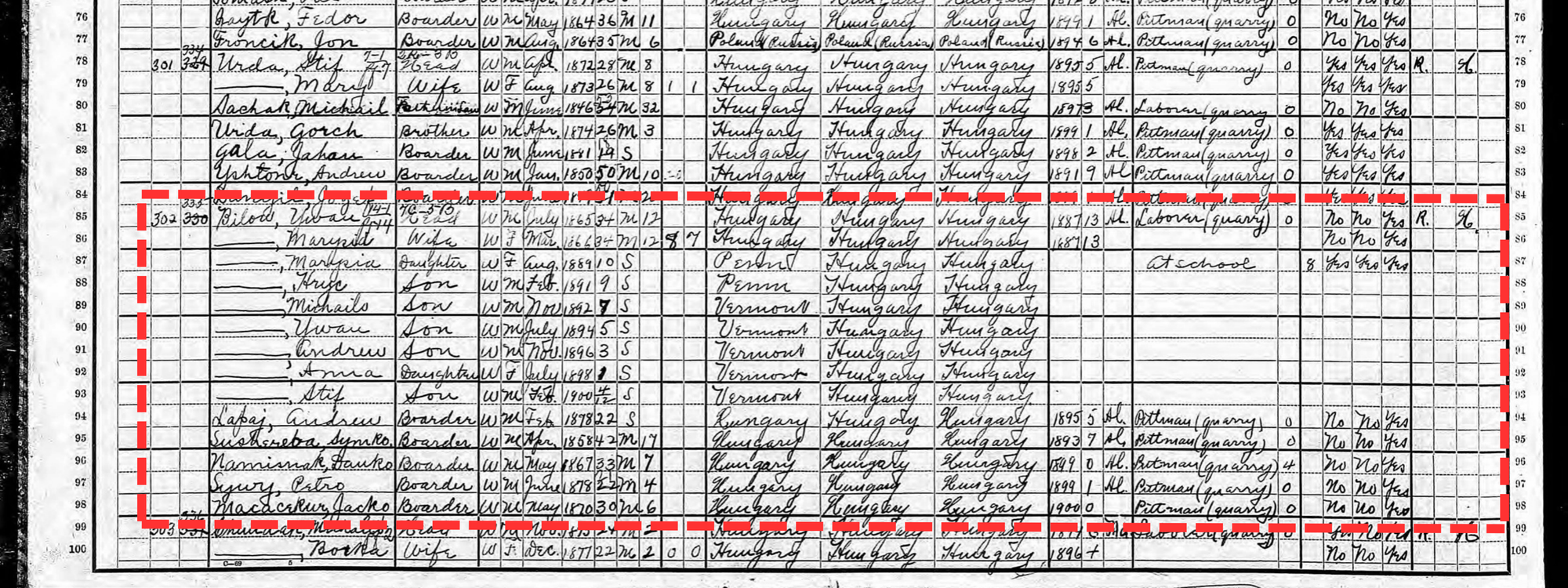
For this particular household, the "head" is listed as Ywan (Ivan?) Bilow – perhaps another relative of mine, who knows! There is his wife, Marysia, and 7 children under him. Then, there are 5 men listed below who are categorized as "boarders" in the "Relationship to Head of Family" column.
All 5 of these men were born in the Austro-Hungarian Empire, listing their birthplace as "Hungary" and they had all arrived in the US much later than the Bilows. The latest arrival had come to the US that same year, 1900, while the earliest arrival out of the boarders had come to the US in 1895. Comparatively, the Bilows had arrived in 1887, illustrating how more established immigrant families helped newcomers as landlords in the late 1800s/early 1900s.
Now, back to Granville. 🙃
Long houses in the Alley had 4 to 5 apartments per building with detached, outdoor bathrooms. One long house could be home to 15 to 18 people at a time. Both my grandfather Basil and grandmother Mary grew up in long houses in Granville's Alley.
My grandmother would take on boarders...these were small apartments...at one time, my father said to me, she had six kids and nine boarders...you know, seventeen people are [just] jammed in there. And, of course, for the boarders [they would have to] do their wash and feed them. My father told me my grandmother would make a big soup [and] the boarders would always eat first. And [then] the boarders would leave the table and the kids got what was left...you fend for yourself. – Mike Labas
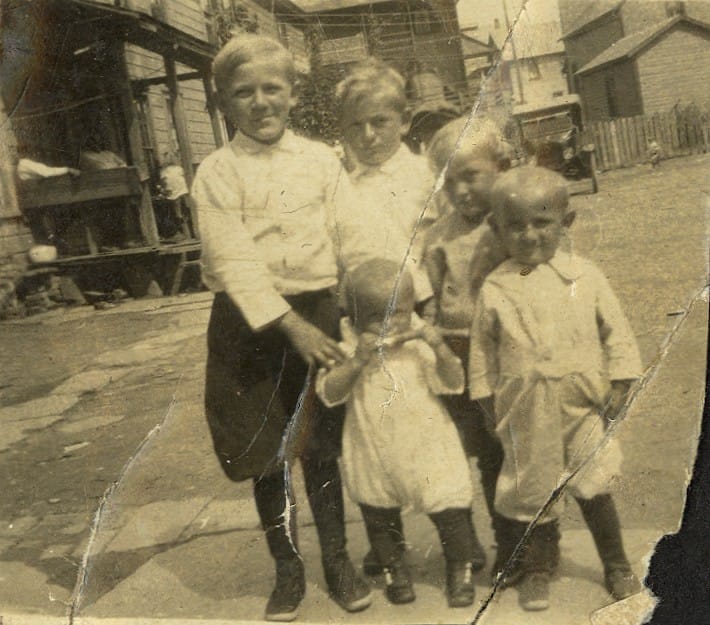
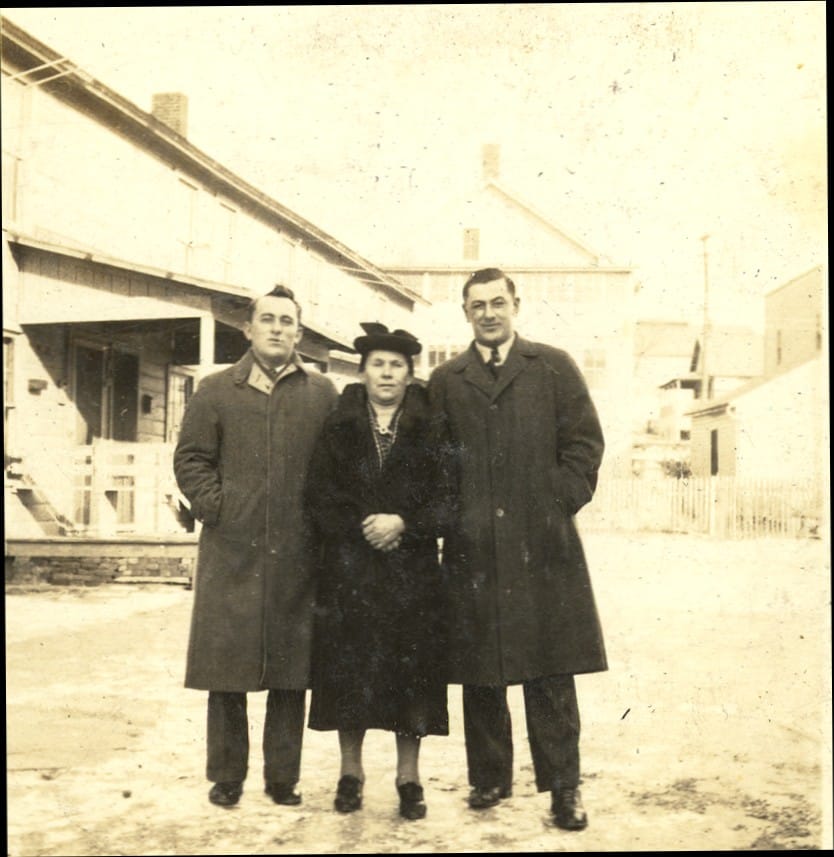
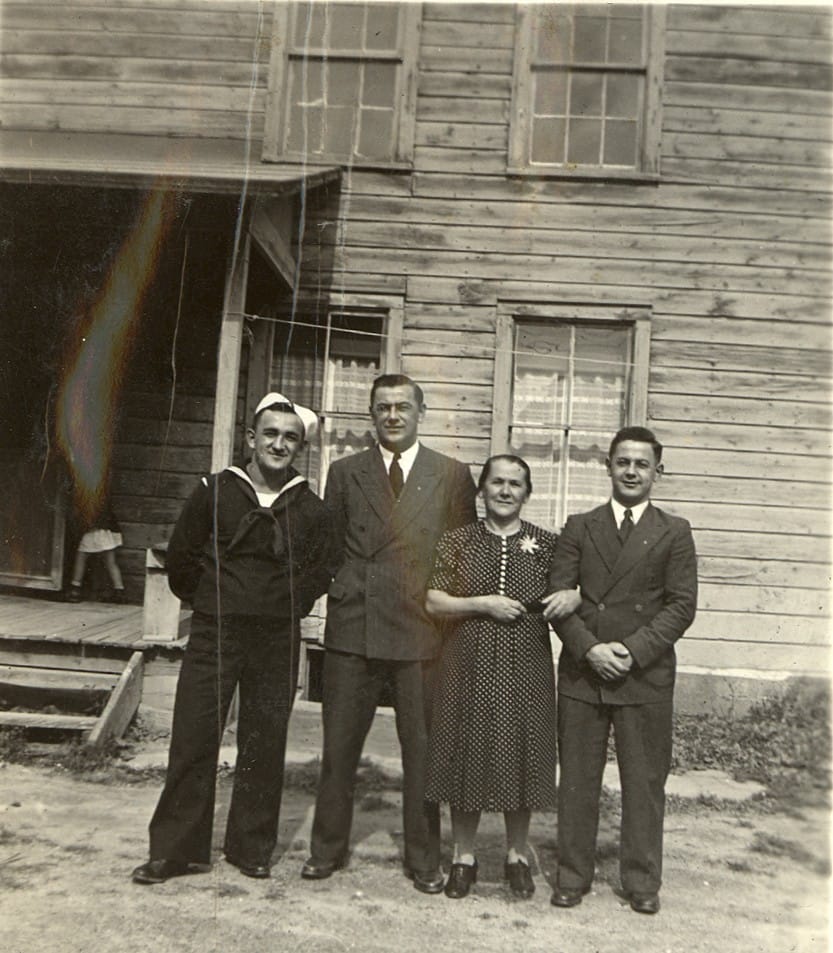
Members of the Labas family in early/mid 1900s outside of Alley long houses (images courtesy of the Slate Valley Museum)
Midwives helped birth children in the long houses, "Slavish people" brewed their own beer and root beer in their homes, and every long house had its own vegetable garden to help feed its residents. Rusyn Americans took great pride in their homes – several interviews I listened to at the Slate Valley Museum testified to the importance "Slavish people" placed on cleanliness. According to one interview with Mary and Bill Prehoda (my first cousins once removed), every Saturday was treated as a communal wash day and that, afterwards, "you could eat off the floors" of any "Slavish" person's home.
Festive occasions also took place in the long houses. Most notably, engagement and/or wedding parties (which lasted several days and maintained homeland traditions like changing a bride's hairstyle to mark her transition to married womanhood and wearing kroje) and visits from the jaslichkary/jasličkári carolers during Christmastime.
Several oral history accounts I listened to noted the interviewees' fond childhood memories of the jaslichkary carolers – it seemed this tradition was still taking place in Granville well into the 1950s/60s.
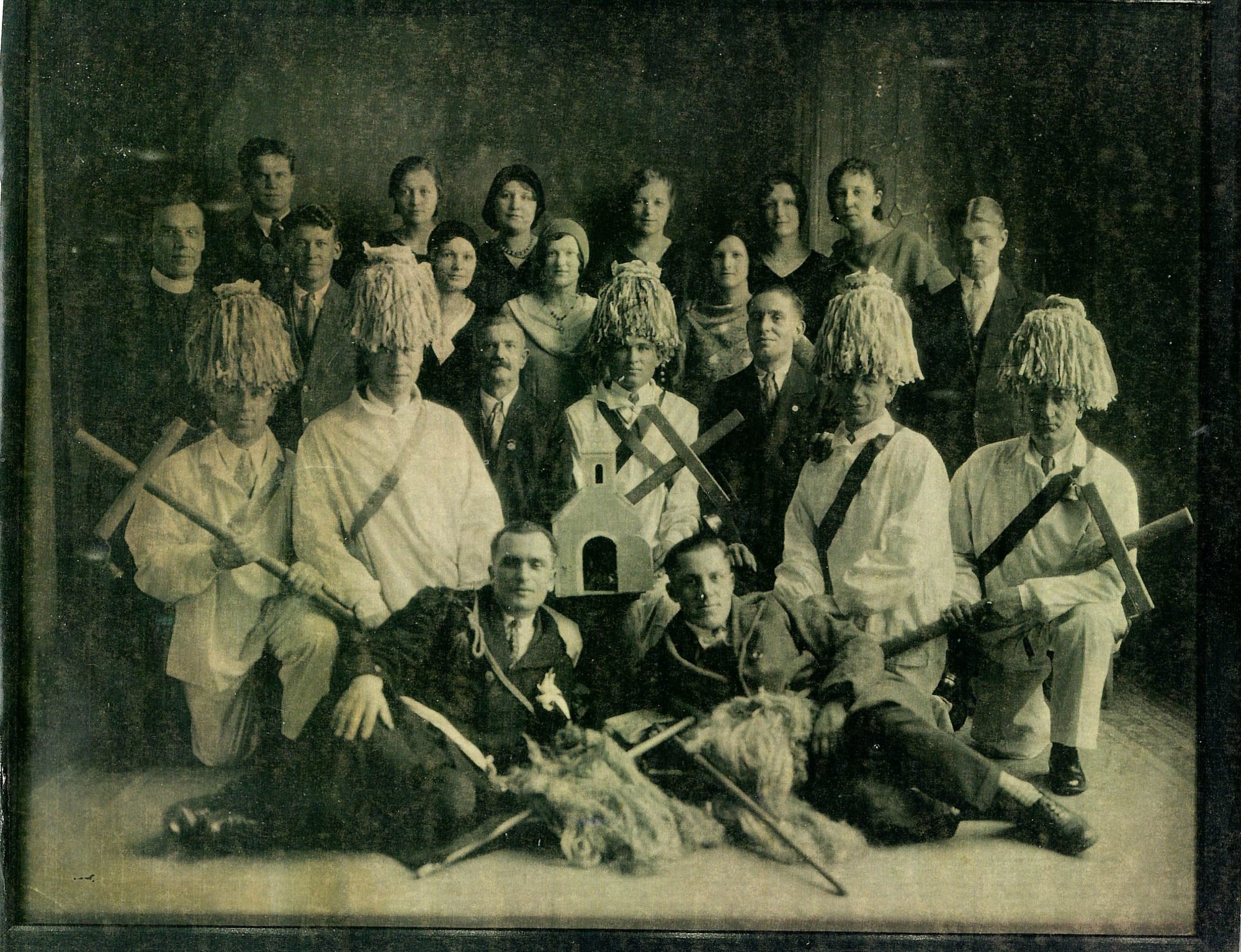
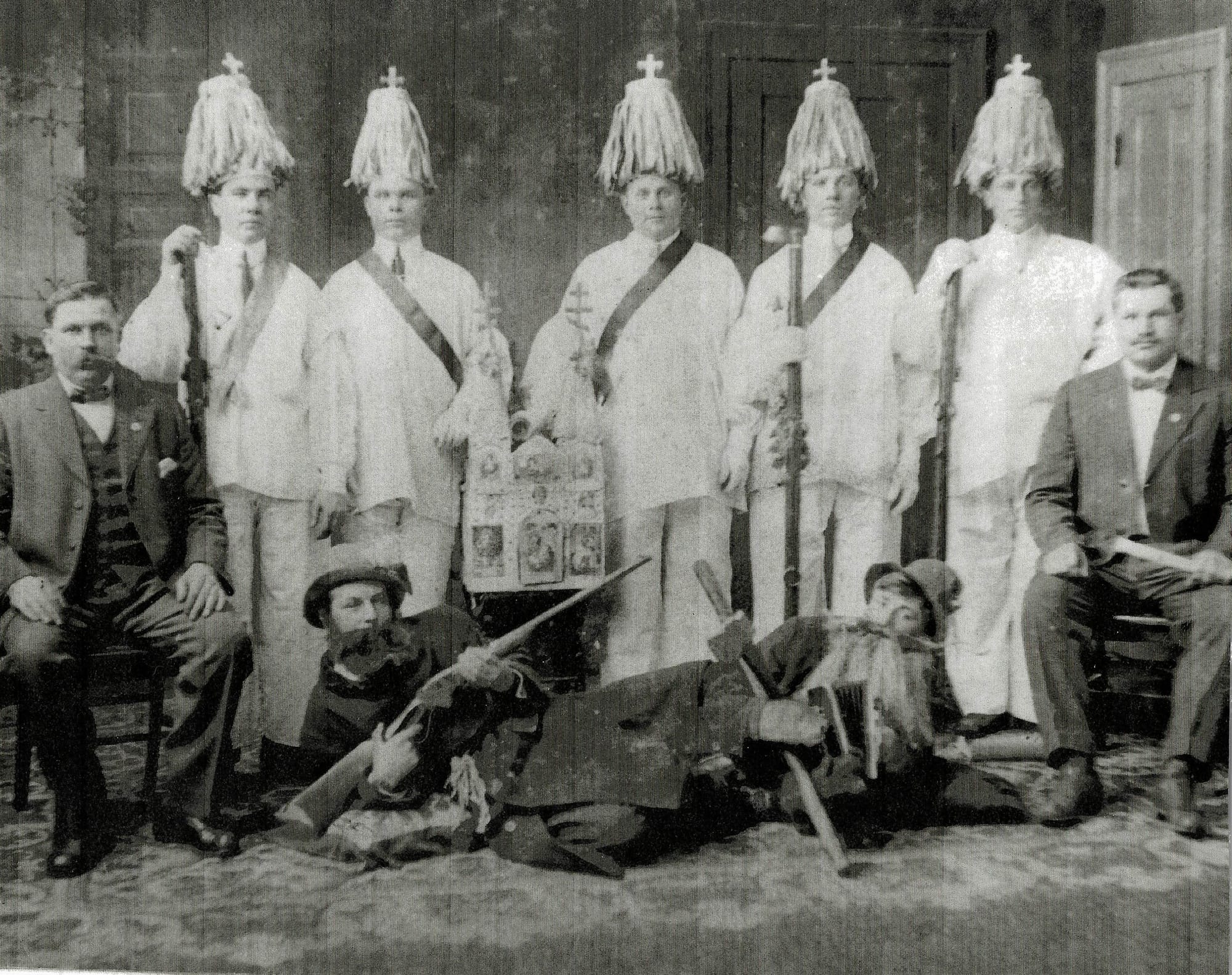
Jaslichkary carolers in early 1900s Granville, NY (images courtesy of the Slate Valley Museum)
In the late 1800s/early 1900s, Rusyns and other Eastern European immigrants kept to themselves in the Alley. Some Italians would later come to live in the long houses, but for the most part their residents would remain Rusyn, Slovak, and Polish.
There was a distinct division in Granville between the wealthy residents of Western European origin and impoverished residents of Eastern European origin. Brawls and knife fights would break out in the streets between ethnic/class groups. There was also the occasional murder.
You could start a fight with the Poles or Hungarian people by calling them a greenhorn or dumb hunyak. – John "Red" Zayachek
While Eastern European men and boys were working under Western Europeans in the slate quarries, Eastern European women and girls faced a similar situation in the domestic realm.
Like boys, most Rusyn girls did not attend school for long or at all before starting work. While Rusyn girls and young women often stayed home with their mothers and grandmothers, learning needlework and how to keep a home, others were employed as domestics in the households of wealthier Granville residents.
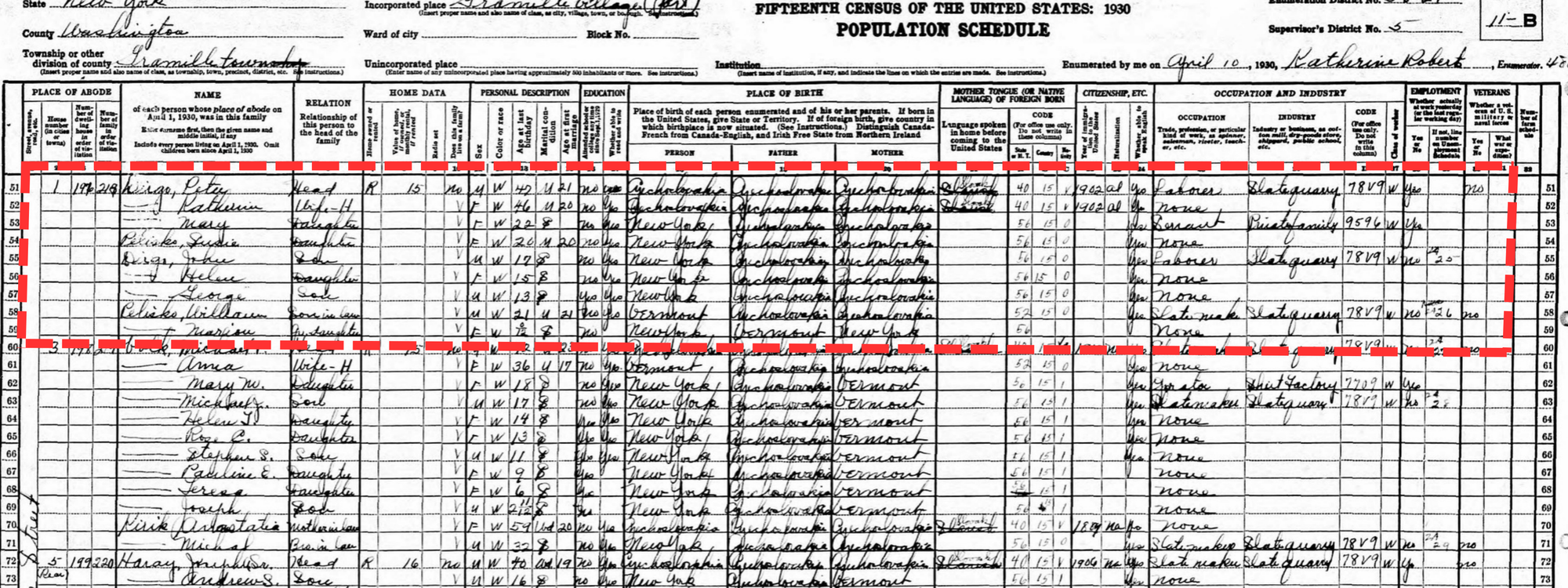
Above is a selection from the 1930 US Census. Here, my grandmother Mary (née Dirga) is 22 and listed as a "servant" employed by a "private family" in the area. I haven't been able to find any record of Mary's employment prior to this document, so I'm not sure at what age she began work as a servant.
Considering the extent of power Granville residents of Western European origin held over those of Eastern European origin, wealth disparities, religious/cultural/linguistic differences, and good ole fashioned prejudice, it's no wonder that there was such distrust and distaste between the two communities.
An interesting outlier was the Granville Jewish population. There had been two major waves of Jewish immigration to Granville, the first being of German Jews in the early/mid 1800s and the second of Eastern European Jews in the late 1800s/early 1900s. (I highly recommend reading up on Granville's Jewish history on the Slate Valley Museum website if you're interested!)
Unlike in denser urban areas, Jews who came to rural Upstate New York started out as traveling merchants rather than laborers. Those who opted to settle in Granville established their own businesses and so straddled the stark class division between the upper class quarry owners/management and lower class quarry laborers.
I always remember my grandmother would come to church and, on her lapel, she had a silver Jewish star. She was so proud of it. When my grandmother was in Czechoslovakia, of course, there were peasants working in the field and a Jewish family took her in when she was eleven or twelve years old and taught her how to be a domestic...and that Jewish family that took her in over there helped her gain passage here. – Mike Labas
There was a noted degree of respect between small business owners, many of whom were Jewish, and their Rusyn customers. Rusyns and other Eastern Europeans were known for paying their debts and insisting upon mutual fair treatment.
The Hungarians had a passion for paying debts, so their credit was good...[local business owners] respected the hunkies. – John "Red" Zayachek
The Eastern European Jews of Granville seemed to have a surprisingly close and amicable relationship with the Eastern European Christians who inhabited the Alley. In the late 1800s/early 1900s, Eastern European Jewish residents helped Rusyns without a strong command of English to interpret legal documents and to navigate life in the US.
[Morris Rote-Rosen] would help them interpret legal papers, how to get a note from the bank...how to read a deed or something...Morris Rote-Rosen and Albert Berkowitz and a lot of Jewish people helped them interpret the things they needed to know. – Mike Labas
Morris Rote-Rosen, born in 1890 as Meisha Roterosen in Lithuania, came up several times in the Slate Valley Museum collections as one of the most beloved Jewish champions of Granville's Rusyns, Slovaks, and Poles. Here, in a selection of his unpublished autobiography donated to the museum by his daughter, Rote-Rosen describes his feelings about the Eastern European community and his work with them as an interpreter (even in a murder case!).
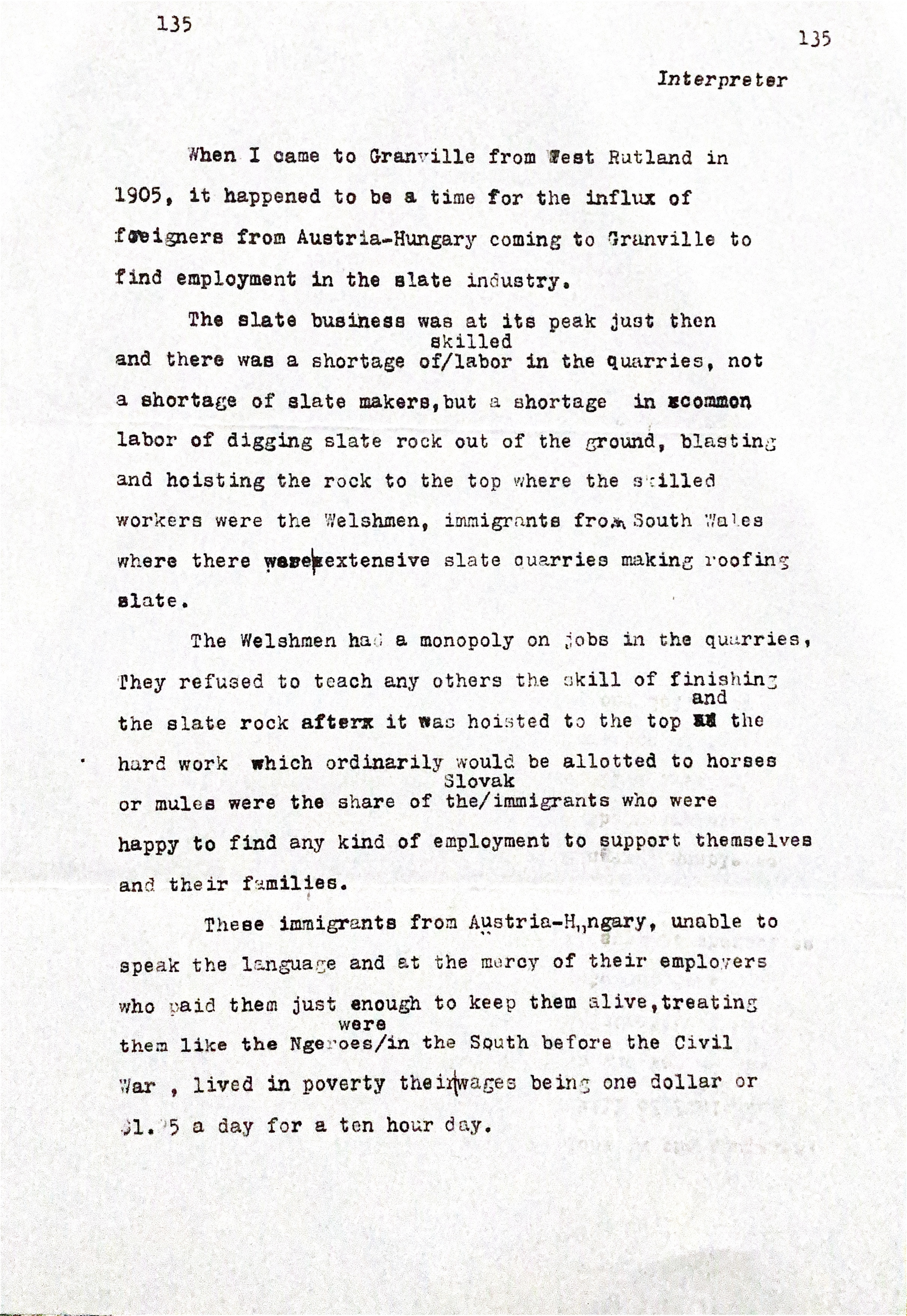
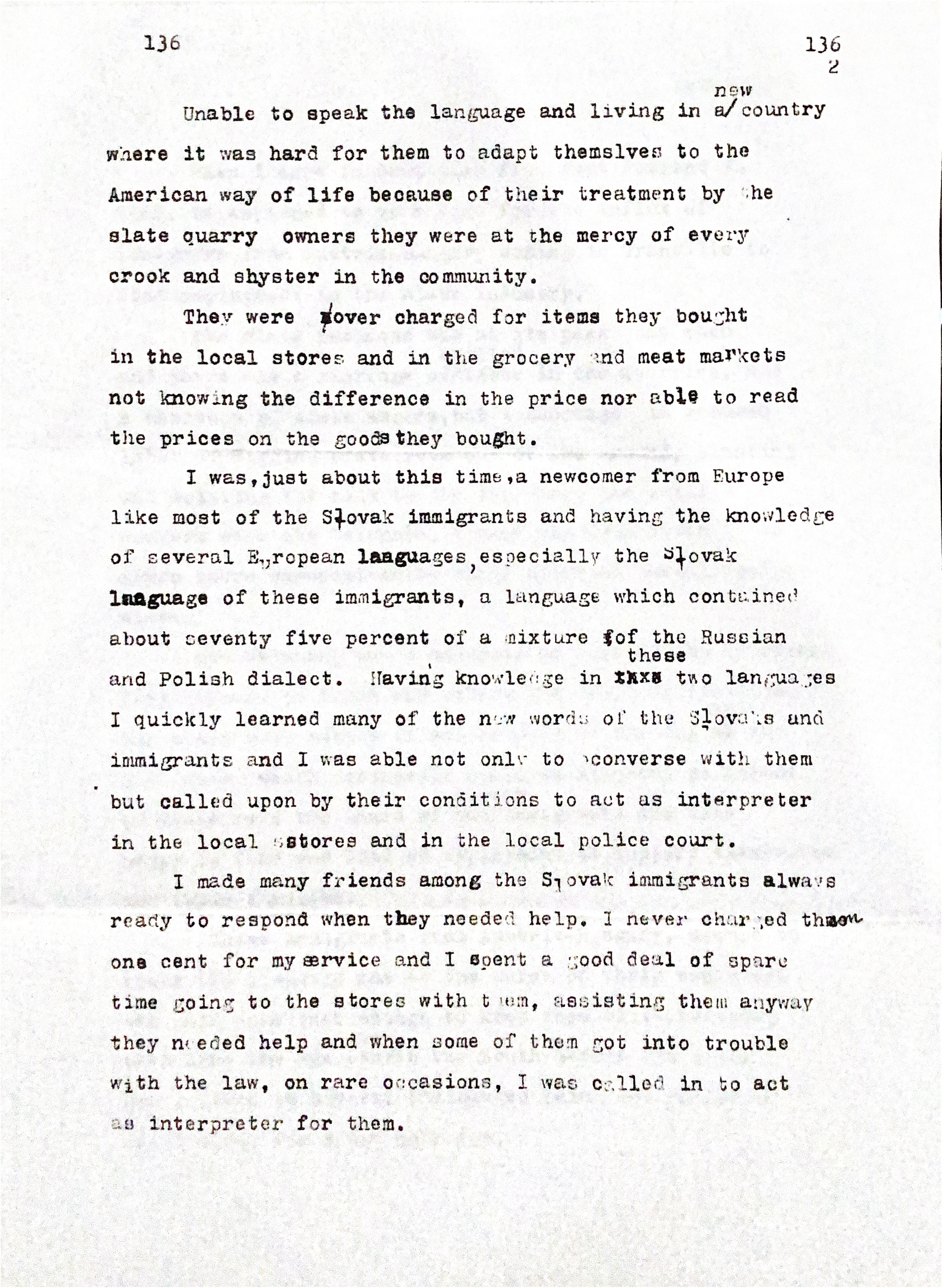
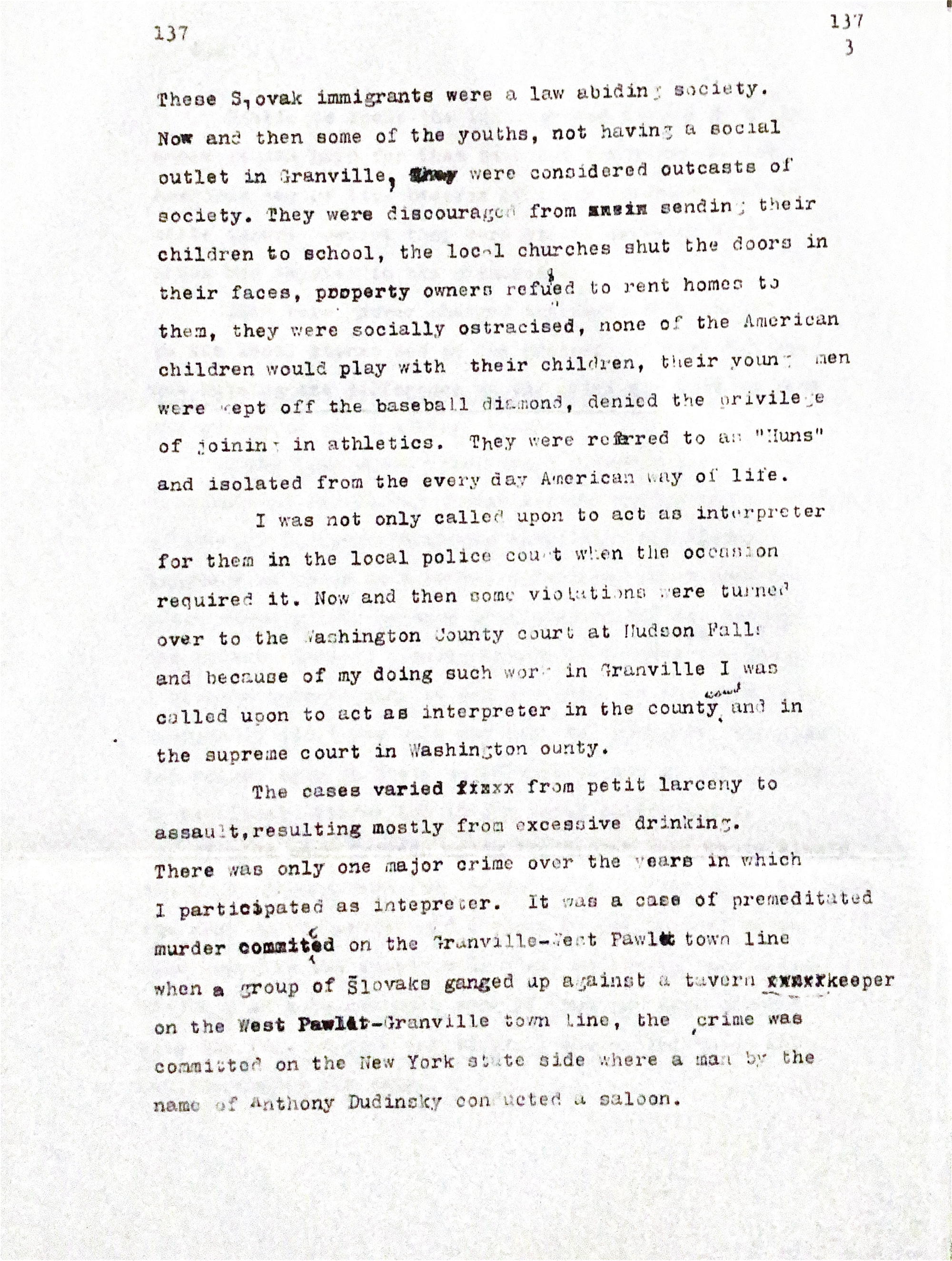
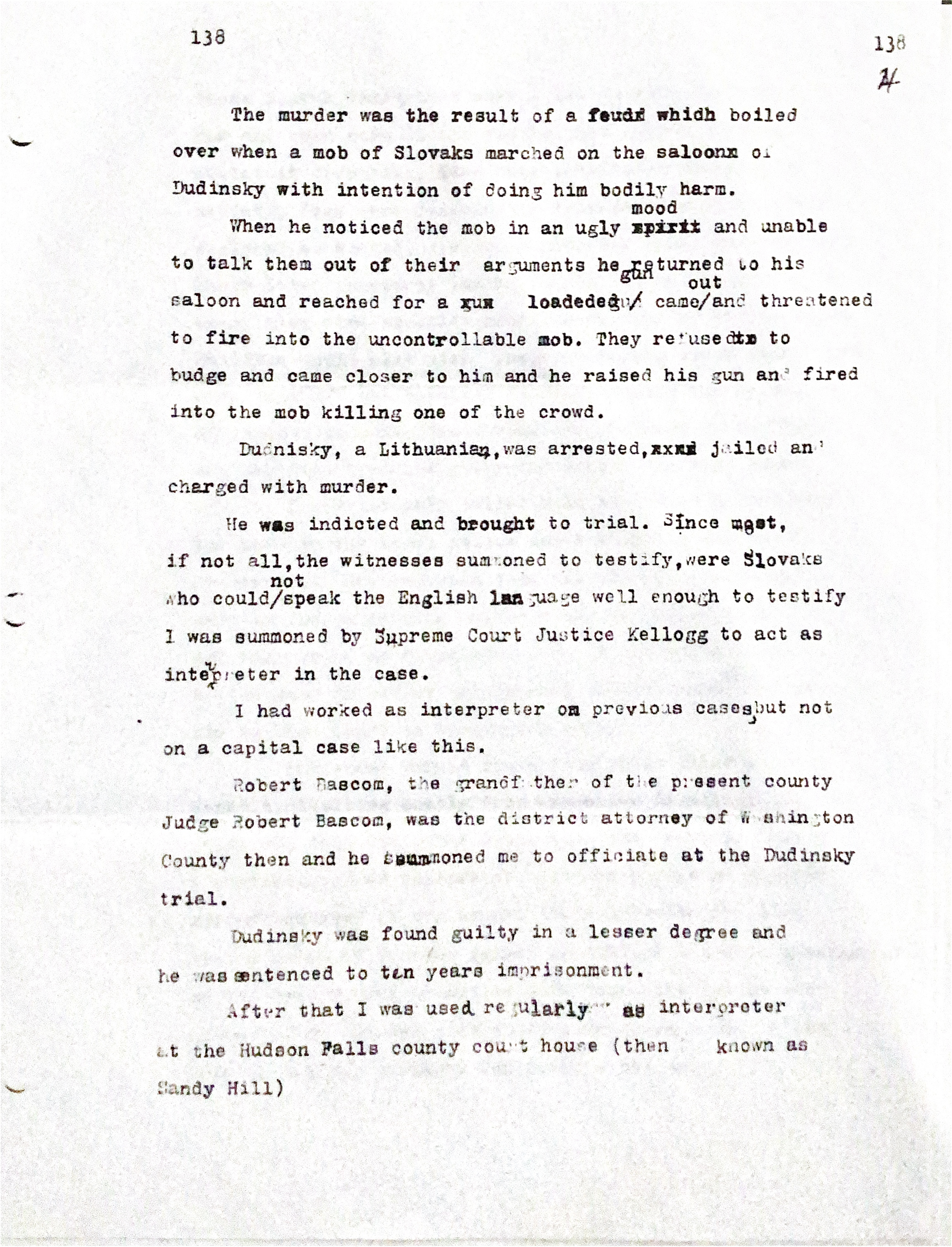
Images courtesy of the Slate Valley Museum
Indeed, as his daughter wrote, Rote-Rosen certainly "had a special rapport with the underdog." Rote-Rosen's admiration and kindness towards the "Slavish" community of Granville appeared to be lifelong. At the age of approx. 71, in 1961, Rote-Rosen published this article in The Granville Sentinel that further details his thoughts on the plight of Eastern European immigrants in the Slate Valley.
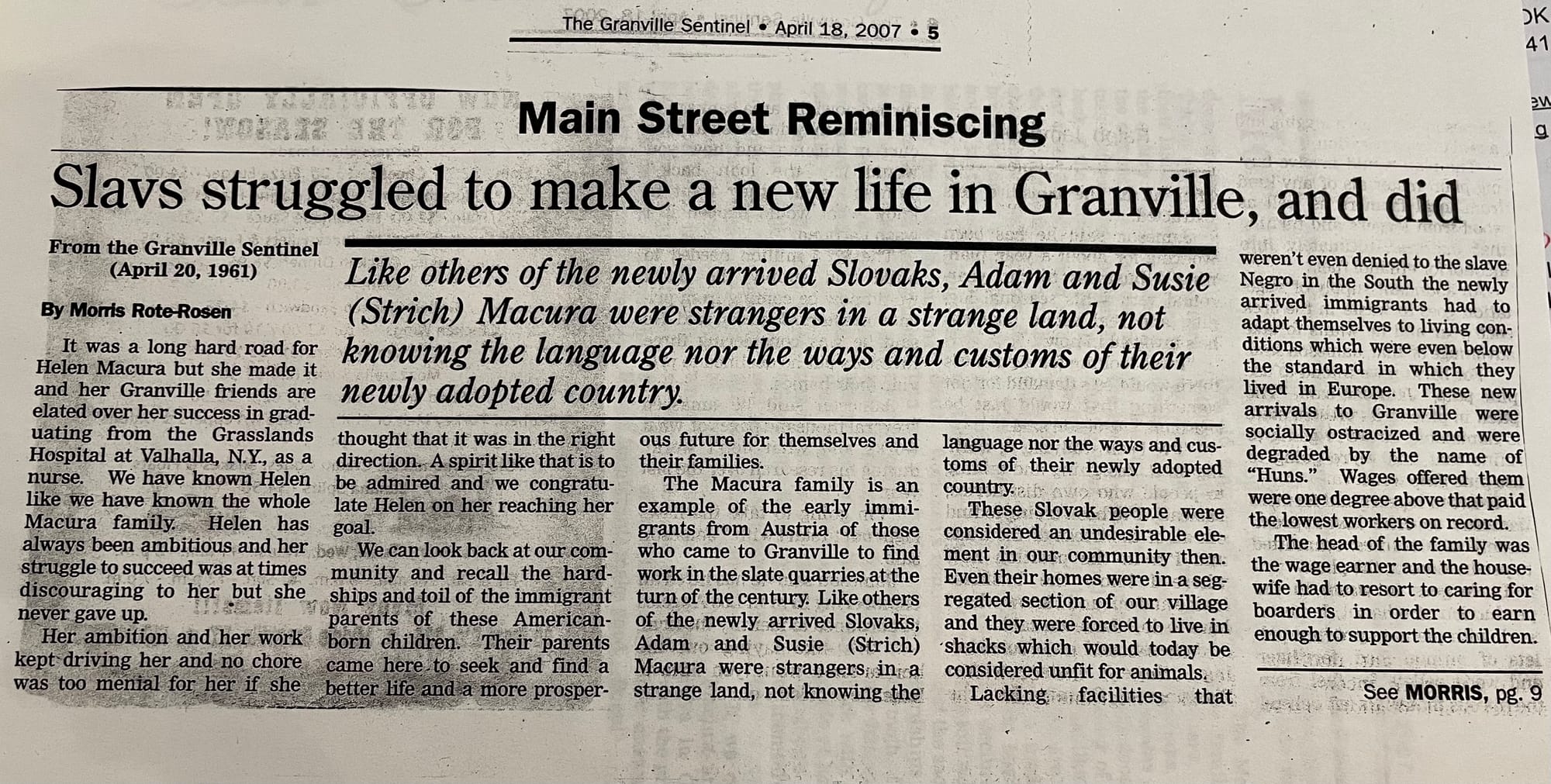
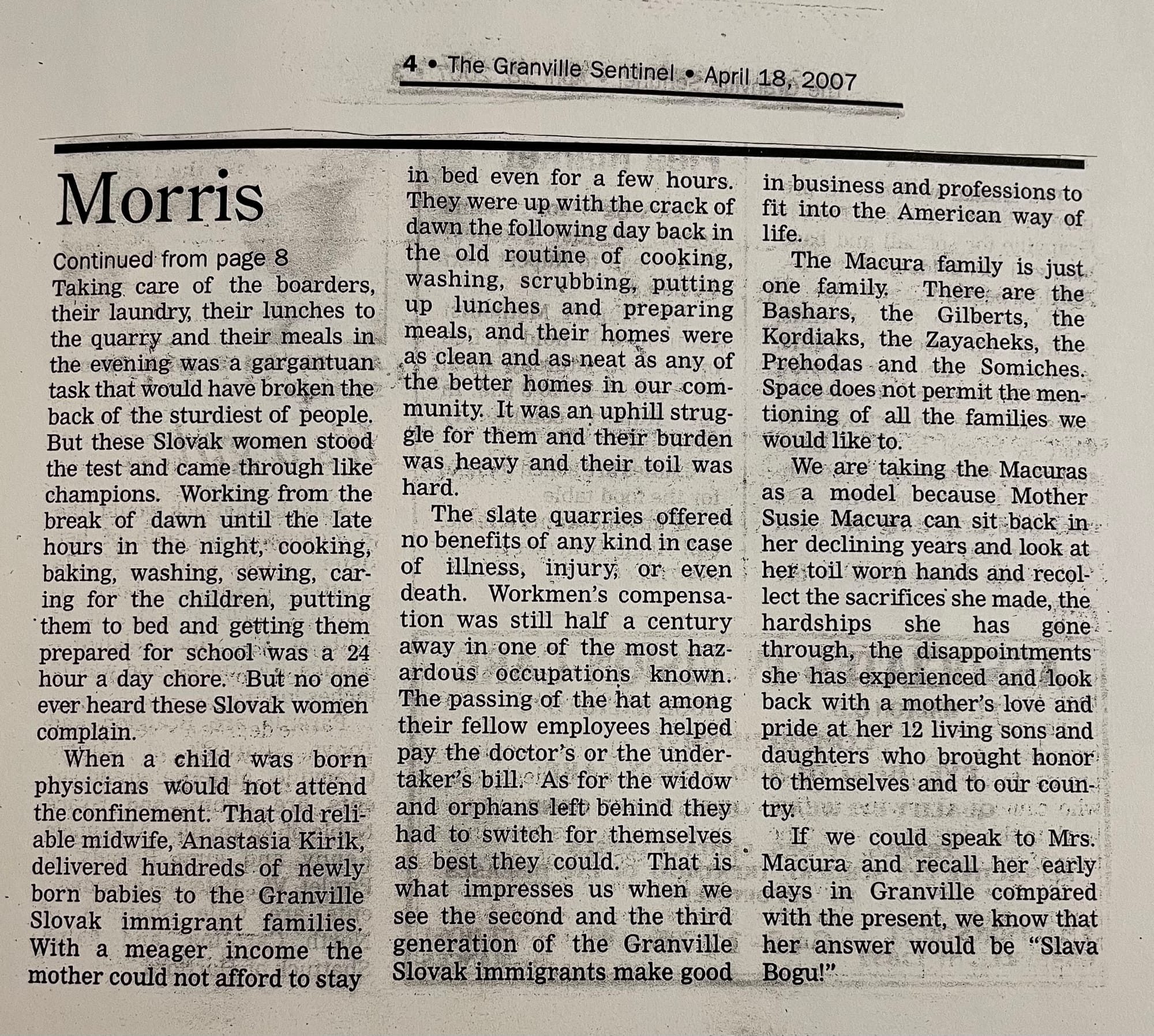
Images courtesy of the Slate Valley Museum
With time, interethnic tensions began to fade. In the mid 1900s, children of Eastern European origin finally had the opportunity to attend school alongside their Western European counterparts (for more than a few years of primary school, that is). Growing up alongside one another and creating shared childhood memories was integral to this generation's coming together as one community and building interethnic friendships.
...as a child, I would go to different friends' houses and one might be Italian and one might be Polish, and Welsh, and so on...I tried all their different foods and everything and I was always welcome at all the kids' houses and they were always welcome at mine. – Jack Williams
While interethnic prejudices still existed, they had significantly softened and were less likely to result in violence. In my own family, my grandparents frowned upon their sons deciding to date and/or marry women who were not some variety of Christian Slav as late as the 1970s...but they seemingly gave up the fight a few weddings in.
Still, in the mid 1900s, the Alley retained its reputation as the wrong side of the tracks. Bars opened all along Water Street and the area became notorious for seedy nightlife.
...the Alley...I think all of us old timers still call it "the Alley"...as a youngster, good people didn't go there...it was pretty rough. There was only one policeman at the time and he was the chief of police, but on Saturday nights they had two or three [special police]...I was fortunate enough to know one of them...Red Zayachek...and he was a special police officer and a pretty good sized fellow...I remember, as a youngster, sneaking out on a Saturday night...and you could hide under there or sit up there [on the freight dock]...and you could see the whole Alley...you could see at least one fight, all kinds of things...there was a knifing. I don't think there was any shootings, but a couple of murders were committed... – Jack Williams
This was the Alley of my father and uncle's generation, a time when upper class Granville residents might still one of them a "hunky," but this was no longer grounds for fisticuffs nor was it the vitriolic slur it had once been.
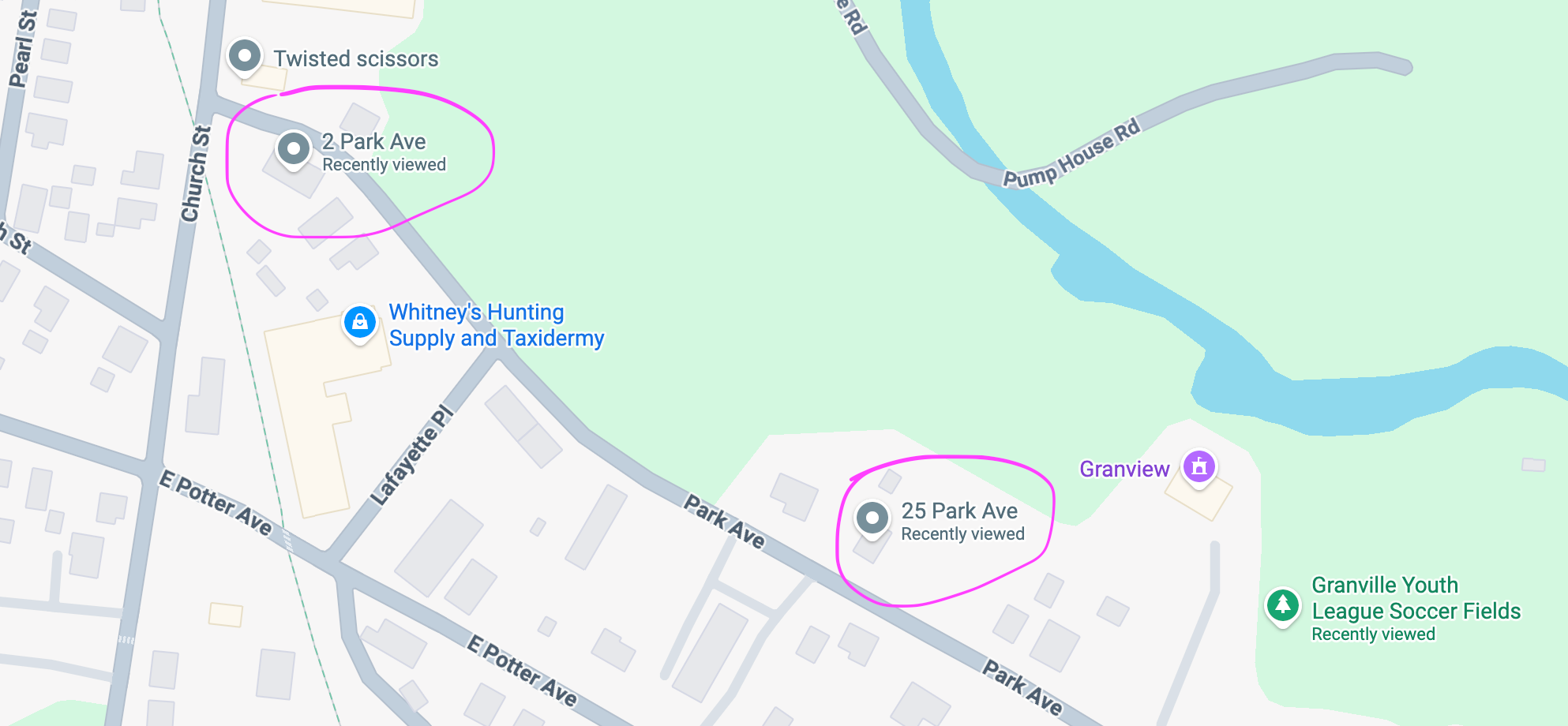
Visiting Granville in early October 2026, the streets that once made up "the Alley" don't reflect much of this raucous history. Park Ave, where my grandparents lived, is peaceful and green. There's a few homes, some in better shape than others. Most of the long houses have either been leveled or were destroyed in fires decades ago. There's a hunting supply and taxidermist shop.
One long house, where my grandparents lived before they could afford their own house a few doors down, still stands. The street runs along the Mettawee River, one direction leading to a rec field and the other to the dormant Byzantine church.
The Saint Peter and Paul Ruthenian Byzantine Catholic Church and its place in Granville's Rusyn community warrants its own newsletter...
Research Into Writing & Final Thoughts
Whew! That was a lot of information and, honestly, it didn't come close to covering everything I learned at the Slate Valley Museum and from this visit to Granville. I mean...come on, I didn't even get to tell you about the different colors of slate!
But for the sake of my sanity and yours, dear reader, I think we best wrap things up for now. 🙃
I went into this research with a few ideas for short stories inspired by Granville and Rusyn Americans' work in the slate industry there. I'm much more comfortable writing stories that are close to my own lived experience, whether they be fiction or creative nonfiction, so drafting stories that are set in a time and place I myself haven't lived in has been uniquely challenging.
Listening to oral histories and reading accounts left behind by past Granville residents has been instrumental in developing my characters' voices, their motivations, and the architecture of their lives. Beyond fleshing out my current drafts and learning about my own family history, I left the Slate Valley Museum with completely new story concepts I otherwise would've never thought of!
I am so grateful to Alissa McIntyre and the Slate Valley Museum staff for their support and insights. I can't recommend this museum enough to those who are interested in Rusyn American history.
I can't wait to integrate this work into my writing! ❤️